
The market for items like coins worth money, antiques, or other things you can collect always shows two prices.
The first price is the honest amount of money exchanged during a real sale. The second price is the money the seller wants to receive.
Often, the second price is very different from the first amount.
Your job as a buyer involves learning quickly how to find the real market amount, helping you avoid spending too much money, and giving you protection against scams.
The process of checking the price must always rely on facts, never depending on feelings or on advertising stories.
Understanding the Good Market Price
The good market price is a specific number of dollars. This number represents the money for which an item moved from the seller’s hands to the buyer’s hands under normal trading conditions.
Such a price is not created by just one person. It comes from many successful sales that happened recently.
For a price to be a market price, it needs to meet several rules, confirming the sale was fair:
- The sale happened between two people who did not know each other before the deal.
- The seller did not have to sell the item fast or for cheap money.
- The buyer had all the correct information about the item and its condition before agreeing to pay.
- The money amount was recorded at an open auction or on a well-known buying website.
If an item sells only once yearly, its market price will be less exact.
If sales happen every week, the market price becomes clear and simple to see.
A true price cannot be just the thought of one expert. It always rests upon the history of previous sales.
How to Notice an Overpriced Item
An overpriced item has a selling price that is higher than the market price, but it is not always a part of a cheating plan.
The high price often comes from the seller’s emotions or the seller’s wish to keep the item longer.
The buyer carries the risk of paying too much money when buying an overpriced item.
You can tell the difference between this price and a cheating price by noticing several simple signs.
- The seller does not hurry. The seller can keep the price high for months or even years, just waiting for a buyer willing to pay that much.
- The price includes an extra room. The seller purposely starts with a high price, planning to offer a discount later.
- Slow-moving item. The item stays on sale for a long time, unable to find a buyer. It appeared on selling lists many times, but no one ever bought it.
- Compared to shop windows. The amount matches the prices seen in expensive retail stores, not the prices seen in auction records. Store prices usually show higher amounts than the actual selling prices.
- No history of real payment. You see many announcements asking for this high price, but you cannot find any proof that someone actually spent that money to own the item.
The overpriced item is often just a mistake or too much greed from the seller, not a bad plan to cheat people.
Finding a Manipulated Price
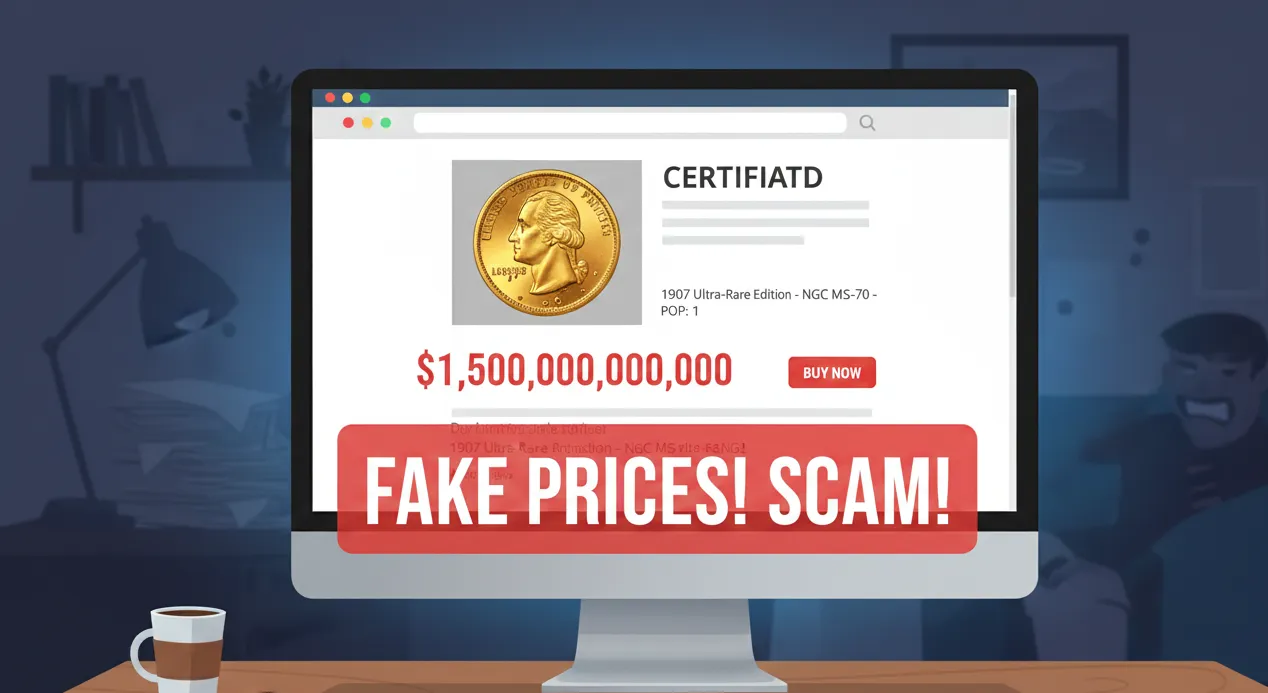
Manipulation means doing something on purpose and actively. It aims to make people believe a price is high when it is not. The goal is always the same: selling an asset to a new buyer for money that is not correct.
Manipulation always leaves traces. You can find these signs by carefully looking at the item’s past and its pricing changes.
- Sudden price rise without a reason. The amount stayed around 1,000 dollars for years, then suddenly jumped to 5,000 dollars in a single month. No major news, discoveries, or changes in how rare the item is in any coin scanner apps have happened during that time.
- Buying the item yourself. The person doing the manipulation uses fake names or their own accounts to buy the item for a high amount. This action creates a false history of sales. Then, the person sells the item to a real buyer, who is a newcomer to the market.
- Creating false excitement. Spreading rumors on social media, in online groups, or through articles, aiming to trick buyers. The rumors might say that “no more of these items are left” or “the price will soon go up ten times.”
- Sales involving an item that is not there. Posting announcements about selling an item that does not exist right now creates the feeling of high demand. The purpose is to show that “demand is high” and “people have already bought everything at this price.”
- Using someone’s good name. Manipulators can point to so-called “famous experts” or “big collectors” who supposedly agree with the high amount. Checking if these words are true becomes impossible.
- Price is going up and down in waves. The amount is raised artificially, holding at the highest point until a buyer appears, and then the amount might drop fast if no buyer is found, acting like a fake pump.
If you notice signs of cheating, the best choice is to decide not to buy the item.
Tools for Checking the Price Yourself
To understand what is real and what is false, you must work with data. You can follow this simple step-by-step plan.
Finding the History of Real Sales
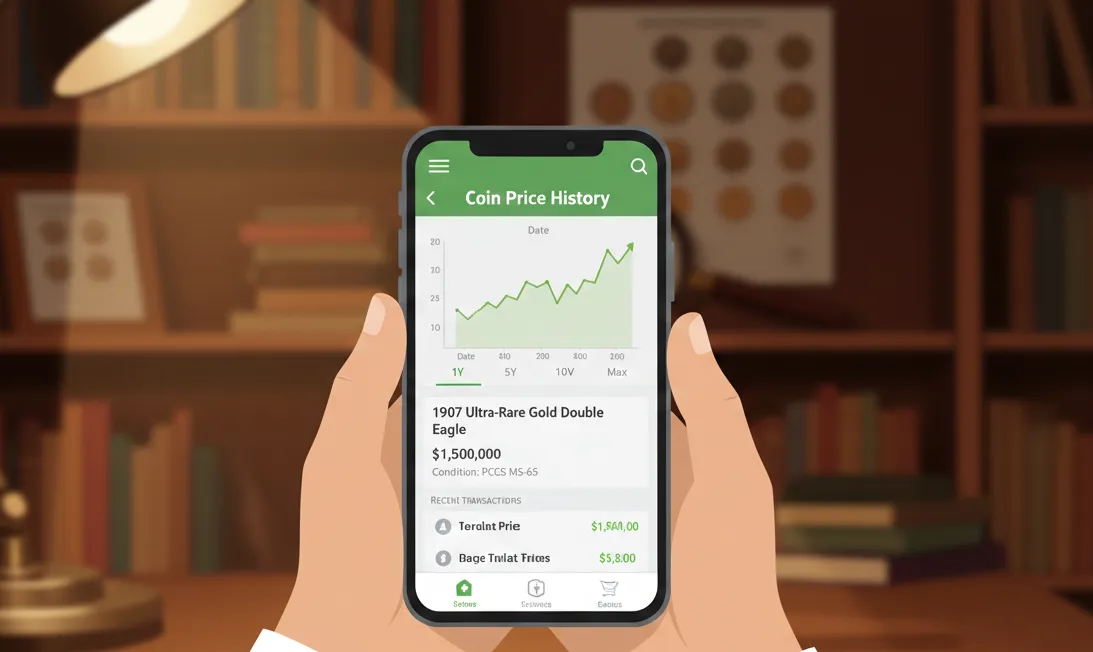
This is the single most needed step. You must know how much this item was paid for, not how much the seller wants to receive.
Use the websites of large world and local auction houses, giving you access to past transactions. These sites have open lists where you can find sales that are finished.
Look for sales from the last six to twelve months, providing the most current data. Older information might not be right anymore because of money inflation or changing public interest.
Always compare items that look exactly the same. For coins, the grade (like MS-65) matters most. For antiques, having all the parts and knowing if it was fixed is needed. An item in perfect shape and an item with damage show two different values.
The auction price often includes a fee that the buyer pays (up to 25%), making the total cost higher. If a seller offers a price “like the auction price,” you should ask if that fee is already included.
Comparing with Similar Items
If your item is rare and has not been sold recently, you need to find a close relative.
Comparing age and amount made.
Take an item from the same year or the same set, but a different version.
If the price for a similar item is ten times lower, the seller needs a very strong reason why your item is so expensive.
Comparing how rare it is.
Look at reports from special grading companies, showing how many items exist in that specific condition.
If 1,000 such coins are known, it cannot cost the same as a coin where only 10 are known.
Checking the public interest.
Look at online groups and social media. Is there a lot of talk about this item? Are collectors looking for it, or is only one seller interested? High interest from many people means the price is fair.
Judging How Easy the Item Is to Sell
Liquidity is the speed at which you can sell an item without losing money.
If similar items sell fast right after going on auction, it shows high interest from buyers. This suggests the price is likely fair.
If the item stays on sale for more than six months, it signals market refusal of the price. This always means the amount is too high, and the seller waits for luck, not working with reality.
A seller ready to talk about the price shows a sign that they know the amount is not perfect, making the sale more possible. A cheating seller or one with an overpriced item often refuses to negotiate because their price is fake.
Getting an Independent Expert Opinion
If the money for the deal is a large amount, paying for a third person’s evaluation is better.
- An expert with no stake. The free coin value app checking the price should not have the chance to buy the item itself, avoiding any conflict of interest. Their job is only to give you a document explaining the value.
- Method used for checking. Ask the expert what way they used to find the price. A good expert always uses the method of comparing past sales. They must give you a list of the sales they used for their decision.
Long-Term Price and Future Growth
Remember that a fair market price today does not guarantee that the value will grow tomorrow, giving you only the current moment’s data. Price only shows one moment in time. You must understand what things will make the price move later.
- The general trend of the market. Collecting often moves in cycles. Sometimes all prices go up. Sometimes they fall. If the whole market is quiet, but your item’s price has suddenly flown up, it gives you a clear warning sign.
- How rarity changes over time. An item’s rarity can change. For example, a big box of coins, previously unknown, might be found, causing the value of all other similar coins to drop. This happens even if they were sold for a lot before.
- Interest and fashion. Demand changes because of what is popular right now. Sometimes a certain time period in history is popular, and sometimes another time is. If the price only depends on what is popular now, it might fall fast when people stop caring.
- The condition of the item. The item’s condition is the one thing that will not change, staying the same always. An item in perfect condition always stays in demand. Buyers who invest money always choose items with the highest grade, offering the safest protection against a price crash.
Your choice to buy must be based on data that you can check and prove, not on the promises given by the seller.
Study the history, compare the condition, and always depend on the fact of a real sale.
This will give you true protection from paying too much or from being cheated.